


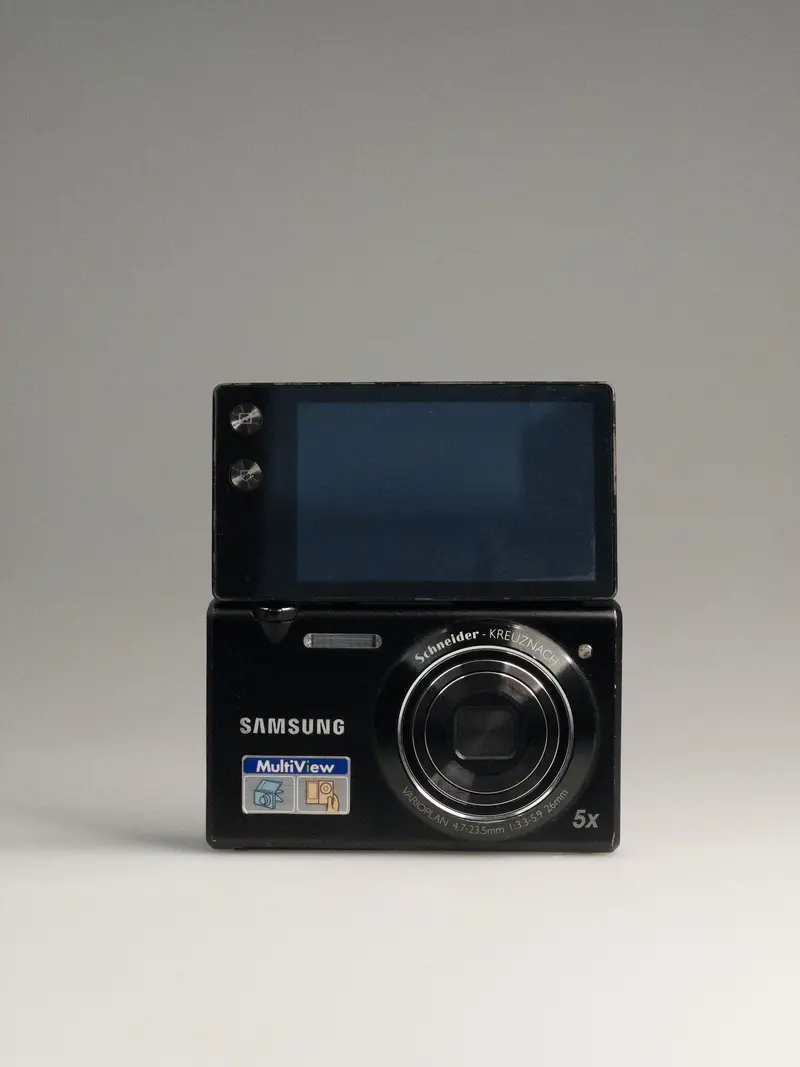
Samsung announced the ST1000 in August 2009 with a spec list that read like a smartphone press release: GPS, Wi-Fi, Bluetooth, a 3.5-inch touchscreen, and a 1,152k-dot display — the highest-resolution screen on any compact camera at the time. It uploaded directly to Facebook. It geo-tagged every shot. It had no physical buttons on the rear. In 2009, this was either the future or an expensive mistake. It was the future.
NO FILTER: SHOT ON ST1000


THE LOOKS
The ST1000 is slim at 99.8 × 60.8 × 18.9mm with a GPS module sitting discreetly on the top plate — the only external tell that this camera carries more wireless radios than most laptops of the era. The rear is entirely screen. Five two-tone color combinations were available: silver/red, black/black, red/black, black/gold, and blue/grey, each one reading more like a phone colorway than a camera choice.
THE SPECS
The Schneider-Kreuznach Varioplan 5× zoom covering 35–175mm is a German optics brand more commonly found in medium-format lenses — here on a consumer compact with dual OIS and digital stabilization. The 3.5-inch touchscreen at 1,152k dots had nearly four times the resolution of the 230k standard — class-leading by a wide margin. GPS, Wi-Fi, and Bluetooth ran simultaneously — the first consumer compact to combine all three. Smart Gesture UI let you navigate by tilting or waving. 720p/30fps H.264, HDMI. 99.8 × 60.8 × 18.9mm, 156g.
DESIGN HIGHLIGHTS
- GPS, Wi-Fi, and Bluetooth all active simultaneously: the first consumer compact to combine all three wireless protocols in one body — in 2009, before this was expected.
- 3.5-inch 1,152k-dot touchscreen: nearly four times the dot count of standard 230k LCDs, and no physical buttons on the rear — the interface was the screen, fully.
- Schneider-Kreuznach Varioplan 5× lens: German optics on a consumer compact at this price was an unusual spec — the same brand found in professional medium-format systems.
THE VERDICT
Most cameras from 2009 feel dated now in obvious ways. The ST1000 feels dated differently — it was doing things that took the rest of the industry three more years to catch up to, and the execution was ahead. The Schneider-Kreuznach glass delivers, the 720p H.264 video holds up, and the 1,152k touchscreen was class-leading by a margin that still shows. A camera that was right about everything except timing.


Rezensionen
Es gibt noch keine Rezensionen.